
 English
Views: 0 Author: Site Editor Publish Time: 2026-11-25 Origin: Site
Tired of endlessly circling crowded parking garages hoping to spot a pair of reverse lights? For many urban commuters, the daily ritual of hunting for a spot is a massive source of frustration. Wasting time retrieving a car during evening rush hour only adds to the headache. Enter the AGV robot. This cutting-edge solution is fundamentally transforming modern parking facilities from the ground up.
Automated parking is widely celebrated for saving precious urban real estate. However, everyday users and facility managers ultimately care most about one thing: speed. Fortunately, automated guided vehicles solve this exact issue with remarkable precision. The average turnaround is incredibly efficient. It often takes just a matter of minutes from the initial request to final departure.
In this comprehensive guide, we will explore the fascinating mechanics behind these rapid retrieval speeds. Specifically, we will delve into how smart navigation algorithms ensure continuous efficiency. We will also examine the heavy-duty hardware that securely transports your vehicle and explain how these robotic fleets maintain flawless operations during the busiest hours of the day.
Speed and Efficiency: The average wait time for a standard automated system ranges from 2 to 5 minutes. This depends heavily on the facility layout and intelligent design.
Smart Navigation: Advanced algorithms act as the brain of the operation. They prevent collisions, manage intersection right-of-ways, and calculate the absolute fastest path to your vehicle.
Handling Mechanisms: Specialized lifting platforms allow for swift and secure movement. They transport vehicles without ever risking damage to the chassis or tires.
Zero Downtime: Innovative automated charging stations and modular power technologies ensure the robotic fleet remains fully operational around the clock.
Space and ROI: Expeditious vehicle recovery directly translates to higher facility throughput. This provides vastly superior user experiences and increased profitability for commercial real estate developers.
Think of an automated guided vehicle as a heavy-duty mechanical valet. It is an autonomous robotic platform designed specifically to slide underneath a vehicle, securely lift it, and transport it to a designated storage rack within a high-density facility. Traditional multi-story garages rely on human drivers navigating complex concrete ramps and tight corners. In contrast, these systems remove the unpredictable human element from the storage equation entirely.
Sweeping urbanization and the severe lack of available real estate in city centers are the primary driving forces behind this technology. Traditional structures require massive amounts of space for driving lanes, pedestrian walkways, and wide turning radiuses. By shifting to robotic transport, developers can fit up to 60 percent more cars in the exact same volumetric space.
Furthermore, hardware plays a critical role in how these ecosystems operate. The market primarily utilizes two distinct types of handling mechanisms. Clamping robots grip the vehicle tires directly. Platform-based robots lift a standardized metal tray that the car rests upon. The choice between these mechanisms directly impacts the overall stability of the vehicle during transit. This stability ultimately dictates the maximum safe operating speed of the machinery.
When evaluating automated storage ecosystems, developers and users alike focus heavily on benchmark speed metrics. The industry standard for retrieval time typically falls between 120 and 300 seconds. This golden 2 to 5-minute window represents the total time elapsed from the moment a user requests their vehicle to the moment the car is presented in the transfer cabin ready to be driven away.
To truly understand the value of this metric, we must contrast it with the traditional human parking experience. In a conventional multi-story garage, a driver might easily spend 15 minutes simply walking to the facility, locating the correct floor, finding their car, and carefully navigating down multiple spiral ramps behind a line of slow-moving vehicles.
During peak hours, traditional garages often suffer from severe gridlock. Automated systems, however, handle high-demand periods through sophisticated algorithmic queuing. The central management software processes dozens of requests simultaneously. It dispatches units in a staggered and highly efficient sequence that completely prevents internal bottlenecks.
Understanding the impressive speed of this technology requires a detailed look at the synchronized steps involved in the recovery process. The operation is entirely automated. It relies on seamless real-time communication between the user interface, the central control software, and the physical robots navigating the grid.
Imagine tapping a button on your smartphone while still riding the elevator down from your office. The retrieval process officially begins the moment this request is initiated. Modern systems offer multiple touchpoints, including proprietary mobile applications and sleek touchscreen kiosks located in the lobby. Once logged, the central management software identifies the exact storage slot of your vehicle. It instantly evaluates the real-time location and battery status of all units in the fleet. The system then dispatches the closest available machine to execute the task.
Upon receiving the dispatch command, the robot silently glides through the dark grid of the facility to the designated parking bay. If the facility utilizes a platform-based system, the robot slides directly underneath the metal tray holding the vehicle. Using highly calibrated hydraulic lifts, the machine gently elevates the platform just enough to clear the concrete storage rack. This delicate lifting process takes only a few seconds. It ensures the vehicle remains perfectly stable and allows the robot to accelerate safely without ever touching the car tires.
With the vehicle securely loaded, the onboard computer calculates the most efficient route back to the transfer cabin. Utilizing omnidirectional wheels, the robot makes precise 90-degree turns. This completely bypasses the need for wide turning radiuses. Upon arriving at the transfer cabin, it lowers the vehicle onto the exit platform. Advanced facilities even utilize integrated turntables within the cabin to rotate the car. This ensures the vehicle is always facing forward. Consequently, the driver can simply open the door, start the engine, and drive straight out into the city street.
Where is the automated parking sector heading? Recent market data shows a massive shift toward predictive logistics and heavy-duty adaptability. Urban planners no longer view these robotic grids merely as space-saving novelties. Today, they are dynamic logistical hubs. The focus has shifted from simple storage density to ultra-high-speed retrieval paired with intelligent energy management.
Current trends highlight the rapid integration of predictive artificial intelligence. Modern management systems now analyze daily user habits. If a tenant predictably leaves the office every day at 5:00 PM, the system automatically stages their vehicle closer to the exit cabin at 4:50 PM. This predictive staging pushes perceived wait times closer to absolute zero. In addition, as electric vehicles dominate the automotive market, the average weight of passenger cars is increasing significantly. The demand for robust robots capable of lifting massive battery-laden vehicles without sacrificing transit speed is skyrocketing. Facilities failing to adopt these high-speed predictive systems will quickly lose their competitive edge in premium real estate markets.
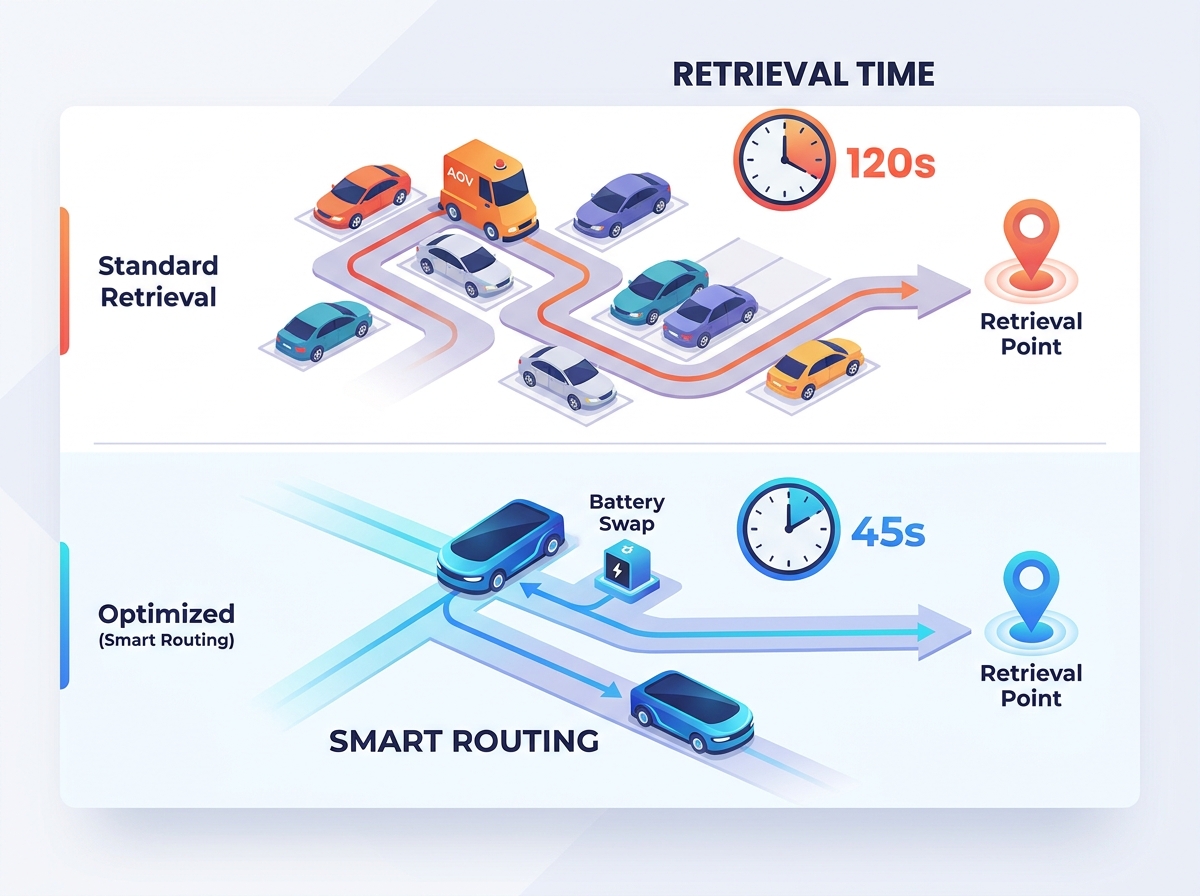
While the baseline speed is undeniably impressive, the actual wait time experienced by a user fluctuates. Several critical structural and technological factors within the specific property dictate this final metric.
The physical geometry of the parking structure heavily influences travel time. A sprawling single-level underground facility will inherently require the machines to travel longer linear distances. In contrast, a compact multi-level facility utilizing high-speed vertical elevators operates much faster. Smart facility design strategically places frequently used transfer cabins in central locations. This minimizes the average travel radius for the entire fleet.
Maintaining the correct ratio of robots to total parking spaces is a delicate balancing act. If a facility has too few units, users will inevitably experience extended wait times during peak hours. The system simply cannot process parallel requests. Conversely, an oversaturated fleet can lead to internal traffic congestion. Engineers conduct rigorous simulation modeling before construction to determine the optimal density. This ensures the fleet perfectly matches the anticipated throughput demands of the building.
Hardware speed is largely irrelevant without exceptional software. Intelligent traffic routing systems function as the digital air traffic controllers of the facility. When multiple units are moving simultaneously, AI-driven software dynamically calculates the most efficient paths for each one. It anticipates potential intersection conflicts and reroutes machines in real-time to avoid gridlock. Furthermore, the software ensures that empty units returning to charging stations always yield to those carrying vehicles. This intelligent oversight is the primary reason automated facilities maintain snappy turnarounds even at maximum capacity.
Moving a two-ton vehicle safely at speeds exceeding 1.5 meters per second is no small feat. It is the result of rigorous mechanical engineering and advanced spatial awareness technologies.
The physical interface between the machine and the vehicle dictates how fast it can safely accelerate and decelerate. A pallet carrier system is widely regarded as one of the most stable methods available. Because the vehicle parks on a standardized steel tray, the robot only interacts with the uniform pallet rather than the variable dimensions of different car tires. This uniformity creates a rigid and secure connection. It completely eliminates the risk of the vehicle shifting during transit.
In contrast, comb-exchange systems use interlocking metal teeth to lift the vehicle directly by the tires. While comb systems save vertical space by eliminating the tray, they require highly precise alignment as the robot approaches the car. This critical alignment phase can marginally impact the initial lifting speed.
Feature | Pallet Carrier System | Comb-Exchange System |
|---|---|---|
Vehicle Stability | Extremely High | Moderate to High |
Lifting Speed | Very Fast | Average |
Load Capacity | Up to 3,000 kg | Up to 2,500 kg |
Alignment Precision | Standardized Tray | Highly Critical |
Best Application | High-throughput commercial buildings | Space-restricted residential projects |
To achieve rapid recovery times, these machines must navigate their environment with absolute certainty. Modern systems utilize Light Detection and Ranging sensors, commonly known as LiDAR, alongside laser-guided navigation. They no longer rely on physical tracks or magnetic strips embedded in the floor. These sophisticated sensors scan the environment thousands of times per second. They map the facility with millimeter accuracy. This incredible precision allows the robot to maintain high speeds in narrow corridors and stop exactly on designated lifting markers without requiring slow incremental adjustments.
A critical logistical challenge in operating a fully automated parking facility is power management. The continuous lifting and transporting of heavy vehicles demands significant energy. If a large portion of the robotic fleet requires charging simultaneously, system throughput collapses. This inevitably leads to unacceptable wait times during busy periods like the end of a workday.
The most effective engineering solution to this challenge is automated battery swap technology. Instead of forcing a unit to sit idle at a plug-in charging station for several hours, the ecosystem utilizes modular power units. When the central software detects that a battery level has dropped below a critical threshold, it routes the machine to an automated exchange station.
Within approximately two minutes, a mechanical sled extracts the depleted module and instantly inserts a fully charged replacement. The robot immediately returns to active duty. Meanwhile, the depleted cell charges independently on a dedicated rack. This continuous operation model ensures that the facility maintains its maximum fleet size and optimal performance capabilities 24 hours a day. It effectively eliminates operational downtime.
For commercial real estate developers, investing in automated parking infrastructure is not merely a space-saving tactic. It is a strategic decision that directly impacts the financial performance and market positioning of the property.
User experience remains a primary consideration in luxury condominiums, high-end retail malls, and Class-A office buildings. Waiting extensively for a vehicle in a subterranean lobby is a major pain point. It can easily tarnish the reputation of an otherwise premium property. By guaranteeing a wait time of under five minutes, developers provide a seamless VIP-level amenity. This significantly enhances tenant satisfaction and long-term retention.
Furthermore, faster recovery directly correlates to higher facility throughput. A system that processes vehicles rapidly handles a higher volume of transient parking turnover. This allows the facility to maximize its hourly revenue. Properties equipped with automated systems that guarantee sub-three-minute turnarounds are seeing a measurable premium in asset valuation.
How do you choose the right system for your project? Do not just look at the marketing brochures. Evaluate the equipment based on real-world engineering standards to consistently achieve the lowest possible wait times.
Verify the Load Capacity: Ensure the robots are rated for at least 2,500 kg to 3,000 kg. Modern electric vehicles carry heavy lithium-ion battery packs. If you install undersized robots, they will struggle with the weight, resulting in slower transit speeds and premature mechanical wear.
Demand Software Scalability: Ask the vendor if their traffic routing software can handle predictive staging. The software must dynamically sort vehicles. Long-term storage vehicles should be placed in the deepest racks, while daily commuters should be staged near the exit cabins. This dynamic sorting naturally lowers the average travel distance for the robots.
Insist on Redundancy Features: Look for systems utilizing modular battery swapping rather than standard plug-in charging. Plug-in units sit idle for hours. This artificially reduces your active fleet size exactly when you need it most during peak demand.
An automated parking robot is much more than a space-saving novelty. It is a highly efficient time-saving machine designed to eliminate the daily friction of urban commuting. By consistently delivering a rapid retrieval time of just a few minutes, these systems fundamentally upgrade the driver experience.
Through the integration of smart traffic routing, ultra-reliable pallet carrier hardware, and rapid battery swap technology, automated parking represents the clear and undeniable future of urban mobility. The days of circling dark concrete ramps and battling for a tight parking spot are rapidly coming to an end.
Property managers, architects, and real estate developers must future-proof their projects. Evaluate your spatial needs and analyze your peak hour throughput requirements. If you want to maximize your return on investment while providing an unmatched user experience, explore the advanced solutions at Dayang Parking. Their state-of-the-art automated parking systems are engineered to meet the highest demands of modern urban infrastructure. Choose the right system today and guarantee lightning-fast vehicle retrievals for decades to come.
Automated parking facilities operate on a highly sophisticated Warehouse Management System tailored specifically for vehicles. When you drop off your car in the transfer cabin, the central server assigns a unique digital profile to your vehicle and maps it to a specific coordinate within the storage grid. The robot utilizes LiDAR sensors and simultaneous localization and mapping technology to navigate directly to these exact coordinates without ever relying on human input or manual tracking.
Modern automated systems are built with extensive redundancies to prevent single points of failure. The central server continuously monitors the telemetry and health data of every machine in the fleet. If a unit experiences a mechanical or software failure, the system instantly flags it as inoperable. The digital routing algorithm immediately recalculates the paths of all other active robots to avoid the stalled unit. A secondary available robot is then dispatched to bypass the breakdown and complete your vehicle retrieval. This ensures your wait time is minimally impacted.
Yes, the hardware is explicitly engineered to accommodate modern vehicle weights and dimensions. Standard platform systems are typically rated to lift and transport loads ranging from 2,500 kg to 3,000 kg. This robust weight capacity easily handles large luxury SUVs, pickup trucks, and modern Electric Vehicles. These vehicles are notably heavier than combustion-engine cars due to their dense lithium-ion battery packs. The load is evenly distributed across the carrier, ensuring safe and highly stable transport.
While the mechanical transit speed of the robot remains constant, a sudden influx of simultaneous requests can create a processing queue. However, intelligent dispatch algorithms manage this queue to sequence retrievals with maximum mathematical efficiency. This minimizes empty travel time for the robots. Furthermore, facilities strongly encourage users to pre-call their vehicles via a mobile app 5 to 10 minutes before arriving at the lobby. This effectively neutralizes the perceived wait time even during the busiest hours of the day.
Facility engineers anticipate power grid disruptions during the design phase. Premium automated parking systems are integrated with heavy-duty backup generators and uninterruptible power supply systems. In the event of a total grid failure, the backup generators automatically kick in within seconds. This ensures that the central server, the communication networks, and the robotic fleet continue operating seamlessly. You will never be locked out of retrieving your vehicle due to a standard city power outage.
Preventative maintenance is absolutely non-negotiable in automated logistics. Routine maintenance involves inspecting the hydraulic lifting mechanisms, calibrating the LiDAR sensors, and checking the wear on the omnidirectional wheels. Facility managers typically schedule these mechanical inspections during off-peak hours, such as late at night, to avoid disrupting user retrievals. Equally important is the maintenance of the digital infrastructure. Regular software updates ensure the artificial intelligence models are utilizing the most mathematically efficient paths to prevent gridlock.